Funding Intelligence
How to Think Like a Successful EU Applicant
Many organisations approach EU funding with the wrong mindset. They invest significant time and resources into developing a proposal, submit it with high expectations, and view rejection as a definitive verdict on the quality of their idea. In reality, this perspective often becomes the biggest obstacle to securing funding.
Successful EU applicants understand a fundamental principle: grant applications are not one-off events. They are part of an ongoing process of learning, refinement, and strategic positioning.
1) Rejection Is Part of the Process
One of the most important lessons experienced applicants learn is that rejection is not unusual—it is expected.
Across many European funding programmes, competition is intense.
Under Horizon Europe, for example, funding rates frequently range between 5% and 15%, meaning that a large number of high-quality proposals will not receive funding. A rejection does not necessarily indicate a weak concept, poor execution, or lack of relevance, but it may reflect the following:
- limited available funding;
- shifting priorities;
- strong competition;
- evaluator preferences within a particular call.
Organisations that consistently secure EU funding recognise this reality. Rather than viewing rejection as failure, they treat it as an opportunity to strengthen their position for future submissions.
2) Every Evaluation Contains Valuable Intelligence
A rejected proposal is far from wasted effort. In most cases, applicants receive detailed evaluation reports, including scores and comments from independent experts.
These assessments provide valuable insight into how evaluators perceive the proposal and where improvements can be made. Common recommendations often include:
- Strengthening the project's expected impact
- Demonstrating clearer alignment with programme priorities
- Providing more robust implementation plans
- Improving budget justification
- Enhancing consortium expertise and complementarity
Importantly, these recommendations rarely require a complete redesign of the project. More often, the core concept remains strong, while targeted improvements can significantly increase competitiveness.
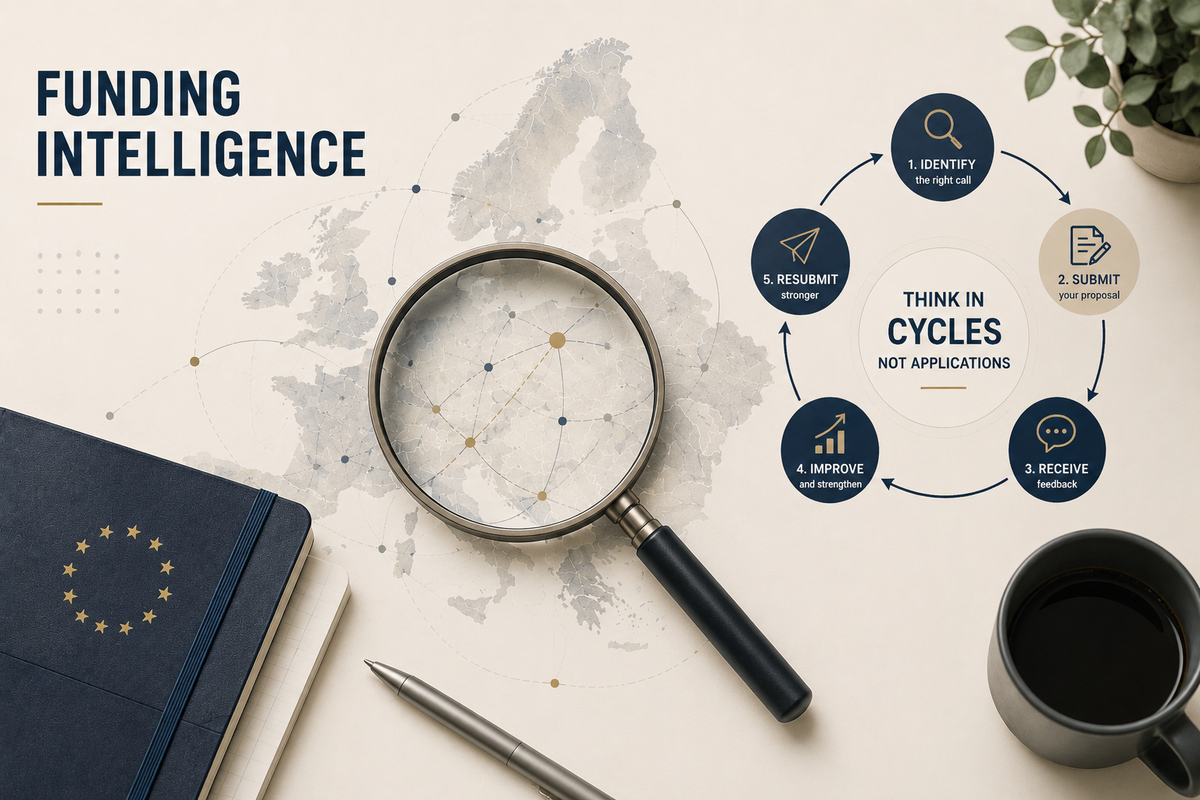
Think in Funding Cycles, Not Individual Applications
Securing EU funding is rarely about a single application. It is about building capability over time.
Experienced organisations plan around funding cycles rather than individual deadlines. They identify relevant programmes, monitor upcoming calls, develop partnerships early, and view each submission as part of a longer-term strategy.
Every application contributes to organisational learning. Teams become more familiar with evaluator expectations, proposal structures, budgeting requirements, and impact frameworks. With each iteration, proposals become stronger and the likelihood of success increases.
This approach also reduces the pressure associated with any one submission. When organisations understand that opportunities will continue to emerge, they can focus on continuous improvement rather than placing all expectations on a single outcome.
3) The Proposal Is Rarely the Main Challenge
For organisations delivering meaningful work and addressing genuine societal, economic, or environmental challenges, the project idea itself is often not the primary barrier.
More commonly, success depends on persistence, strategic alignment, effective partnerships, and a willingness to adapt.
A Long-Term Perspective Delivers Results
EU funding rewards organisations that combine innovation with resilience. Every proposal—whether funded or not—contributes to building institutional knowledge, stronger partnerships, and greater competitiveness.
Rather than placing rejected applications aside, successful applicants revisit them, analyse the feedback, refine the content, and prepare for the next opportunity.
In many cases, the difference between an unsuccessful proposal and a funded project is not the idea itself—it is the commitment to improve and try again.
At EUNETHIS, we help organisations navigate the complexities of European funding programmes with confidence, insight, and strategic support. Whether you are preparing your first application or refining a proposal for resubmission, our team can help you maximise your chances of success.